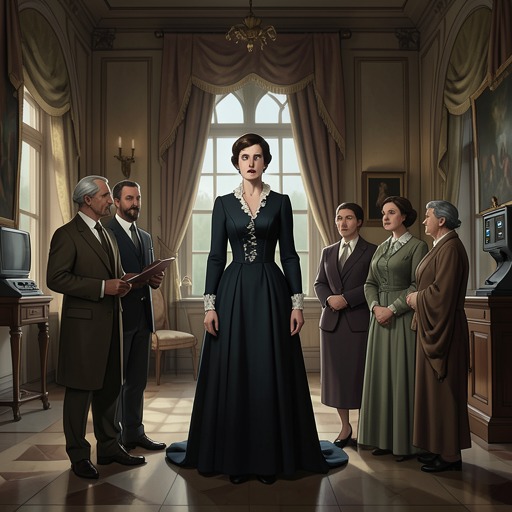
Mona Mayfair and Rowan Mayfair
Blood CanticleMona Mayfair and Rowan Mayfair are cousins whose bond moves from an act of rescue to a wary, painful parting. Rowan’s medical authority and knowledge of the Taltos place her in a position to save Mona, but they also make her an object of Mona’s distrust; their final exchange recognizes that affection remains even as Mona decides to leave their closeness behind.
Identity and the first rescue
The relationship is shaped by a difference in circumstance: Rowan is a physician with knowledge of the extraordinary, while Mona has endured prolonged illness and hospitalization. When Mona is offered transformation into a vampire, Rowan’s cousin is described as having suffered for years, with bruised arms from needles, medicines that made her sick, fever, pain, and the loss of ordinary pleasures such as reading and watching films. The possibility of an eternity without pain matters to Mona not as an abstraction but as the chance to feel whole and breathe freely for even one hour.
Mona reaches for Lestat and agrees to the transformation; Quinn urges Lestat to save her. The decision is not made in a vacuum: Rowan and the Mayfairs are approaching, and Lestat hears their ambulance and limousine arrive at the pecan-tree drive. The scene establishes a lasting tension in the cousins’ relationship. Rowan is part of the family and a powerful medical presence, yet Mona’s immediate survival depends on a choice made by Lestat and Quinn rather than on Rowan’s care.
Medical knowledge and the Taltos
Rowan’s expertise becomes especially consequential when she explains Taltos biology. She describes them as a mammal that evolved separately from Homo sapiens, sharing perhaps forty-five percent of human genes, with a more elongated build and largely cartilaginous bones. Their development is extraordinarily rapid: a fetus may develop within minutes or hours, birth is severely painful, and an infant unfolds as a small adult and begins to mature at once.
Rowan further explains that a newborn Taltos needs its mother’s milk immediately. During the first hour after birth, deprivation can stunt it permanently; with milk and the mother’s telepathic nurture, it can reach its full height in that hour, commonly six and a half feet and sometimes seven feet for males. Nursing may continue for weeks, months, or years, placing a heavy burden on the mother. Rowan adds that the milk can cure humans, while admitting that its full powers are unknown. Her account thus joins clinical knowledge to the bodily cost of reproduction, and makes the question of who may study or protect the Taltos inseparable from the question of who bears the consequences.
The history Rowan and Michael recount complicates any simple division between human and Taltos. Human women who conceive by Taltos males almost always miscarry and bleed to death; human males cause only a small hemorrhage in Taltos females, but repeated couplings over many years can exhaust their eggs. Interbreeding produced malformed children and people carrying Taltos genes, while wars and massacres scattered the less aggressive Taltos and drove them into hiding. Rowan’s knowledge is therefore not merely a professional resource: it concerns a lineage entangled with human violence and with the Mayfair family itself.
A haven, or a laboratory?
The cousins’ clearest later conflict emerges when Lorkyn says she came looking for a haven and found one only after speaking with Rowan for eight hours. Mona immediately challenges the implications. She fears that Rowan’s offer means that the Taltos will be studied and confined in laboratory cages; she points to Lorkyn’s having been knocked unconscious with a syringe on the tarmac beside Rowan’s plane as reason not to trust the arrangement unquestioningly.
Lorkyn rejects Mona’s interpretation. She presents the haven not as a laboratory but as an environment and community where Taltos can live, work, and thrive. She wants to continue her medical studies and become a doctor; Rowan has accepted her as a pupil. Lorkyn also sees fruitful work for Oberon and Miravelle, and describes a self-contained world in which the Taltos can be supervised without conspicuous restraints, protected, and left in peace. Mona’s objection and Lorkyn’s answer reveal a genuine ethical tension rather than a settled verdict: Rowan’s knowledge and authority may offer protection and opportunity, yet the language of supervision and the history of coercive medical intervention leave room for Mona’s suspicion.
The final parting
After the discussion, Mona sits for a long time, occasionally meeting Rowan’s eyes. At last she says softly that it is over. Rowan does not answer. Mona rises with Quinn, and when she reaches the door she turns back to tell Rowan that Rowan will not see much of her anymore. Rowan replies that she understands.
Michael tells Mona that he loves her. Mona stops with her head bowed but does not turn around. The restrained gestures leave the separation unresolved in feeling but decisive in direction: Rowan accepts Mona’s withdrawal rather than arguing against it, and Mona does not deny the family bond, yet she chooses distance. Their relationship closes not with a repudiation of love but with a boundary, set after rescue and renewed conflict over what care, knowledge, and refuge can mean.